Menu
The Search for Next-Gen Weight Loss Drugs
Physiology professor finds brain peptide that could help regulate weight and relieve weight-related pain
By Bethany Mauger |
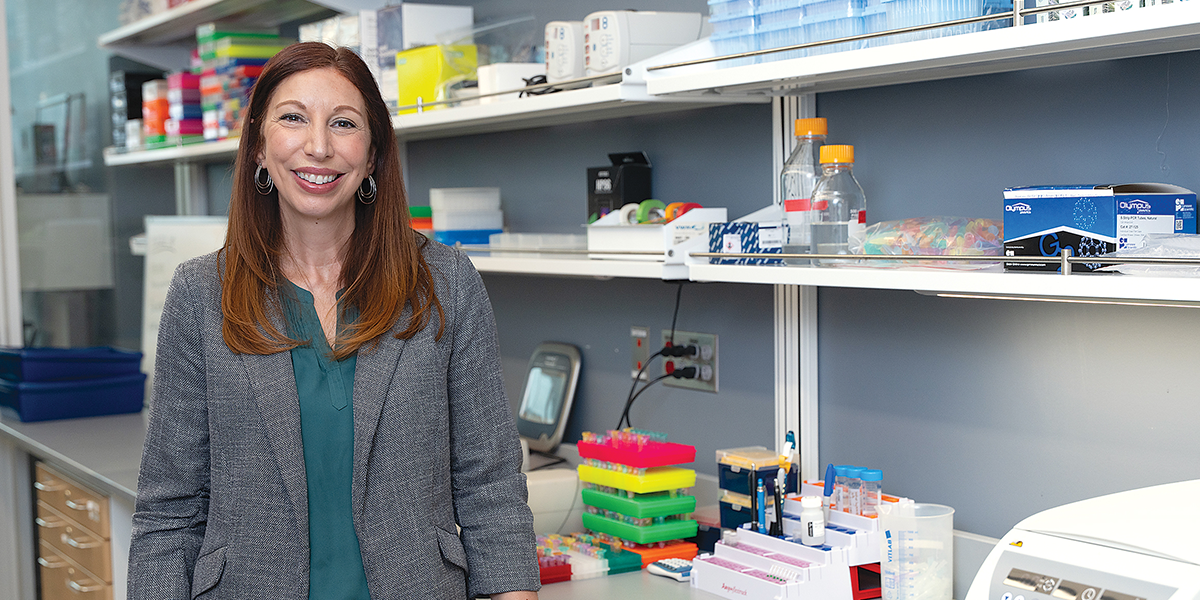
If obesity is a disease, why is it treated like a moral failing?
That’s the question that drives Gina Leinninger as she searches for a cure. The Michigan State University physiology professor is on a mission to find the next generation of treatment to help the brain better regulate hunger cues and, as a result, weight.
Leinninger has spent the last few years studying a peptide in the brain called neurotensin. She says this peptide is different because it could control body weight while also easing the chronic pain that often occurs along with the overweight state.

Gina Leinninger
Spartan Science
What does the brain have to do with weight?
Gina Leinninger
The brain has different areas that trigger when we need to eat. People describe these triggers as homeostatic feeding and hedonic feeding. Homeostatic means, “I eat to live and survive,” and hedonic is more like, “That looks yummy, I want to eat it.”
Gina Leinninger
The brain gets information from hormones secreted below the neck from our adipose tissue, or fat tissue, in the trunk of the body. It works in proportion to how much fat you have. If you’re underweight, your adipose tissue might tell the brain, “Hey, we don’t have enough fat, maybe we should eat a little more.” In contrast, if you have too much, it produces more of the hormone to tell your brain, “Maybe we should tamp down on eating a little bit.” There are other hormones secreted by your stomach when you’re full or hungry that also tell your brain whether you need food.
Gina Leinninger
But other factors affect how we interact with our environment. Even if I’m full, if I see a hot fudge sundae, I want to eat it. That’s probably a holdover from hunter–gatherer days, when the next meal was not a sure thing. This has nothing to do with willpower, because those pathways are hardwired into our physiology. Not engaging in those behaviors would be anti-physiology.
Spartan Science
How did you become interested in neurotensin?
Gina Leinninger
When I was a postdoc, I looked at how a hormone called leptin regulates energy balance, feeding and body weight. I found that one small group of neurons that didn’t respond to leptin but expressed this peptide, neurotensin, making them unique. That meant roughly 80% of the neurotensin-producing neurons in this brain region, which is critical for balancing feeding and body weight, weren’t understood at all. Nobody knew what they did or how they worked. It was an exciting gold mine.
Gina Leinninger
When I told my mentor, he and I looked at each and said, “This is something.” I remember walking to my car and thinking, I think my life has changed. I became so curious about this novelty, this unknown. That’s what led me to focus on neurotensin when I started my lab.
Spartan Science
What were the challenges of working with neurotensin?
Gina Leinninger
Once I started my lab, I realized one of the reasons people hadn’t gone after this gold mine. It was very difficult to study. We had trouble seeing where the peptide was expressed in the brain or the receptors it must bind to in order to send its message. All the wonderful science tricks people use to figure out how neurons work and what they do weren’t available for this peptide. I can’t make a cell in a dish eat or not eat. I can’t make a computational model eat or not eat. If I wanted to study neurotensin and how it modifies feeding behavior, then I would have to invent tools to make that possible.
Spartan Science
How did you watch the neurons in action?
Gina Leinninger
My lab developed mouse models that allowed us to do new things like turning the neurotensin-expressing neurons on or getting rid of the neurons to see how it affected mouse behavior. When we got rid of the neurons, the mice became very obese. When we turned them on, the mice restrained their feeding and lost weight.
Spartan Science
How do you go from manipulating genes to producing a drug that could help people?
Gina Leinninger
Our research is looking for the right receptor to mediate how this peptide suppresses the urge to eat. There are a couple of receptors for neurotensin, and we need to figure out which ones mediate its beneficial effects without adverse consequences. After that, we’ll need pharmacological ways to get to those receptors. There are drugs that can get past the blood-brain barrier to make this approach feasible. We’re working on this with a National Institutes of Health grant and, surprisingly, a Department of Defense grant. That’s because so many veterans are disproportionately affected by obesity and pain.