Menu
The Science of Conception
MSU biochemist reveals how sperm generate the energy to reach an egg
By Connor Yeck |
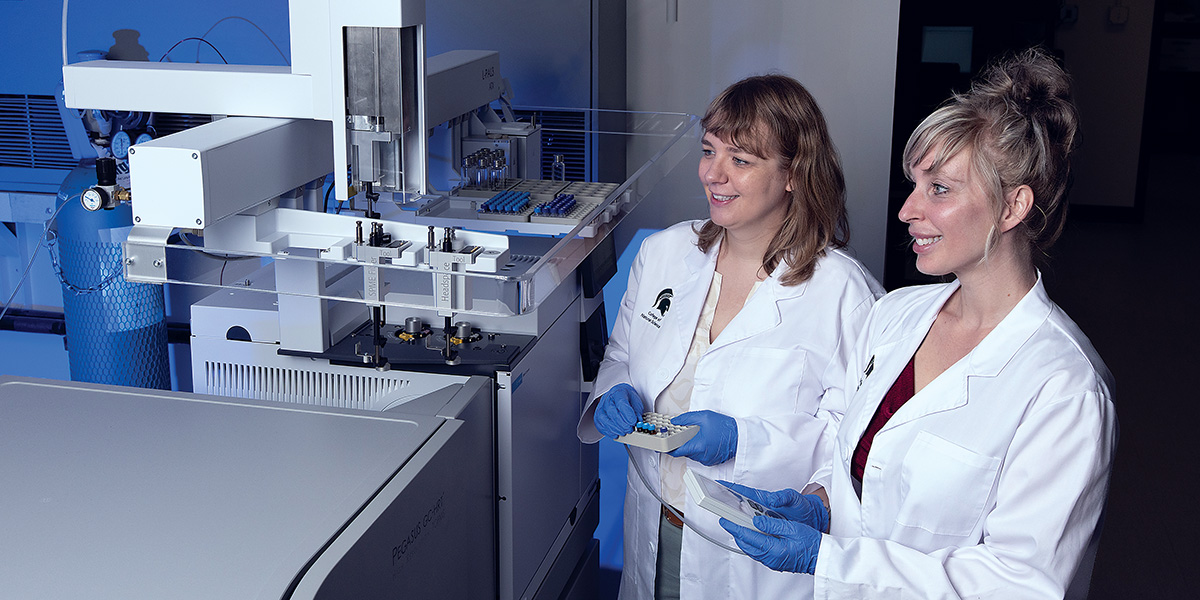
The greatest race on Earth doesn’t include cyclists peddling their way through the snow-capped Alps or stock cars burning rubber at the Daytona 500.
Instead, you’ll find 20 to 200 million single-cell participants battling for one, evolutionary prize: fertilization.
To Melanie Balbach, an assistant professor in MSU’s Department of Biochemistry and Molecular Biology, the age-old race of sperm toward an egg isn’t just a question of who crosses the finish line, but how.
Through a series of headline-making breakthroughs, her team is unpacking the metabolic mysteries behind mammalian reproduction — namely, how sperm cells just one-fifth the width of a human hair handle the massive burst of energy needed to get themselves swimming.
In addition to pulling back the curtain on life’s most fundamental mechanisms, her science is sparking new conversations linked to reproductive health, culture and policy.
Knowing how sperm successfully reach an egg means scientists could one day better diagnose and treat infertility.
Inversely, knowing how to temporarily stop sperm from reaching their goal raises the prospect of a world-changing creation: an on-demand male birth control.
No hormones, no problem
It was during her time as a post-doctoral researcher at Weill Cornell Medicine that Balbach made a discovery still reverberating through the world of reproductive science.
When testing an enzyme-blocking compound on mice originally meant to treat an eye disorder, she had the hunch to check if there could be an impact on sperm as well, knowing a biochemical link existed.
What followed was a eureka moment many scientists dream of.
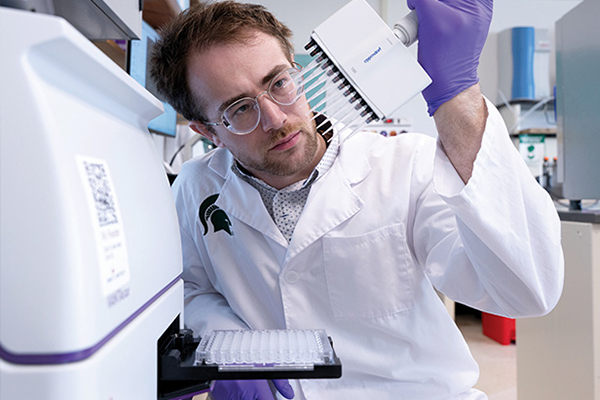
George Dobson, postdoctoral research associate, inspects samples in the multichannel micropipette.
Peering into the microscope, Balbach saw the sperm had been stopped cold, lacking the whiplash movements needed to reach an egg. Then, over the course of a few hours, they slowly shook off their stupor and got back to swimming.
From that moment, the implications were clear.
Current female birth control methods come with eye-watering lists of side effects, and ongoing efforts to create a hormone-based “male pill” promise much the same. Starting and stopping hormonal birth control also takes days or weeks depending on the exact pill, shot or implant — not exactly ideal for spontaneity.
With the discovery of a speedy enzyme-inhibitor, here it seemed could be the first steps toward exploring an on-demand male birth control that, if successful, would shake up the way we think of reproductive health.
“Imagine taking a pill half an hour before intercourse to temporarily lose fertility,” said Balbach. “This would give men and women so much more agency when it comes to family planning.”
Fuel for the finish line
Discovering how to slow sperm down is just one part of the vast biochemical puzzle Balbach continues to unravel at MSU, and since arriving in 2023, her lab has made huge strides in learning what makes them go.
Before ejaculation, mammalian sperm rest in a low-energy state, and it’s only through a time-sensitive process called “capacitation” they achieve the changes needed to become supercharged swimmers capable of fertilization.
“Going from sleep to a full sprint in an instant — that’s capacitation,” said Balbach, who sees reproductive metabolism as a powerful tool for precision medicine.
For instance, while a person’s sperm count might look healthy by the numbers, there could still be underlying energy issues preventing sperm from making it anywhere near an egg.
“One really great way to improve assisted fertility techniques overall is to improve our diagnosis of infertility in patients,” she explained. “Metabolism itself is one key area that’s often overlooked.”
And what exactly does a scientist need to study reproductive metabolism?
"The future of reproductive science is about providing greater agency, better care
and really changing the way we think about fertility…"
Mass spectrometers, which characterize the constellation of small molecules found in samples, and flow cytometers, which quickly measure the chemical profiles of single cells — not to mention specialized microscopes aptly named “computer-assisted sperm analyzers.”
Having these instruments at her fingertips was a huge draw for Balbach in bringing her lab to East Lansing.
“I tell people, being at MSU is like being a kitchen that has every single gadget you could ever need. So, if you decided to make pasta tomorrow, there is a pasta maker ready to go,” she said.
Leveraging these facilities, Balbach’s lab has chalked up several first-of-their-kind discoveries that are helping lift the hood on a sperm’s metabolic engine.
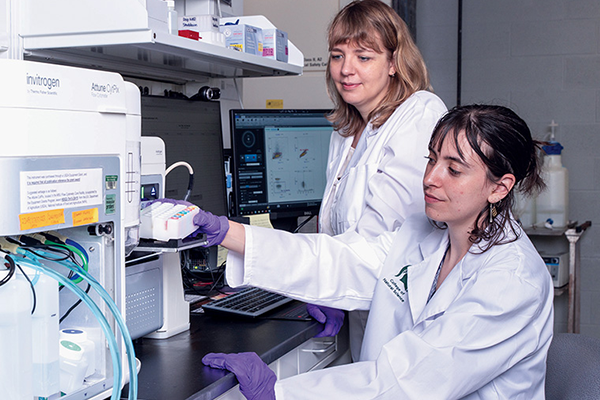
In one recent experiment, her team revealed how mammalian sperm meet their incredibly high energy demands — a longstanding mystery among scientists.
By tracking the metabolism of glucose, which mice sperm use as fuel, they discovered how an enzyme called aldolase helped convert this glucose into usable energy.
The team also found certain enzymes regulating the flow of glucose like microscopic traffic controllers: promising targets for the development of a nonhormonal contraceptive.
Looking ahead, Balbach now wants to break new ground when it comes to understanding the physiological conditions sperm experience on the way to fertilization.
While sperm can be studied in isolation, doing so bypasses the complex biochemical interplay occurring between sperm cells, seminal fluid and the female reproductive tract.
“It’s important to have a baseline understanding of sperm on their own, but if you want the full picture, you need to put everything in context,” said Balbach.
And it’s through this fuller, molecular picture that Balbach envisions fast-approaching changes to our relationship with reproductive health.
In a country where nearly 50% all pregnancies are still unplanned, an instant enzyme inhibitor would give individuals a new, empowering say in their own fertility, and for those looking to start families, understanding life’s metabolic starting gun is just as crucial.
"The future of reproductive science is about providing greater agency, better care, and really changing the way we think about fertility," said Balbach. "It's exciting to be working at this frontier, and to know it all comes back to one biochemical question: how these cells reach the finish line."