Menu
Reading without Eyes
Sean Crosson studies how bacteria sense the world around them and evolve the tools to cause disease
By Bethany Mauger |
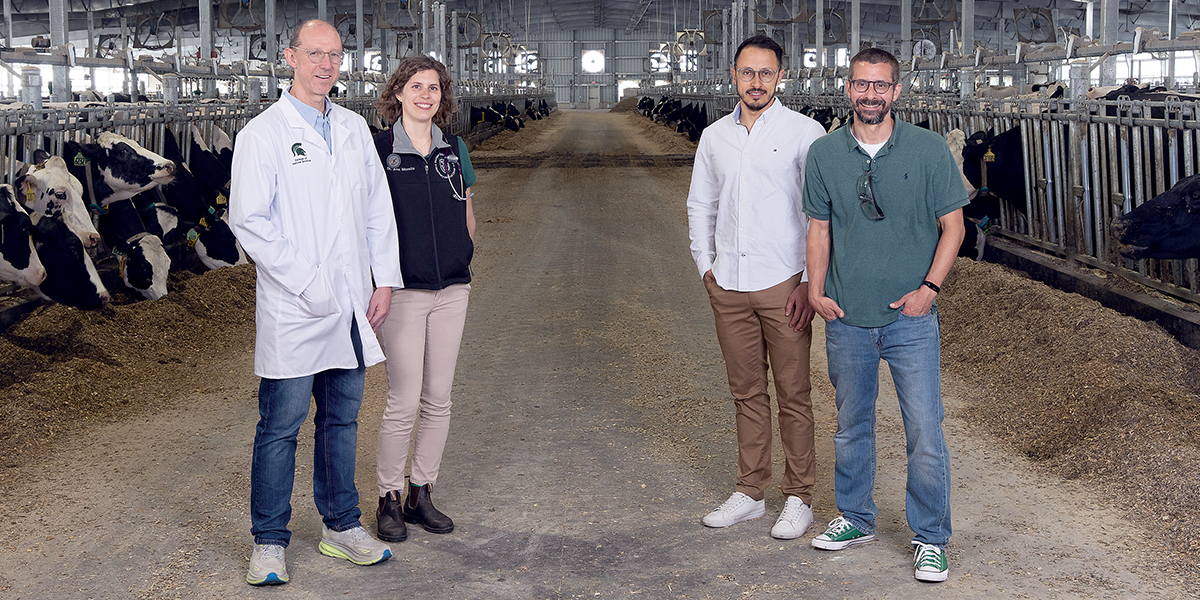
Rudolph Hugh Endowed Professor Sean Crosson (left) is joined by his colleagues Ana Moreira, assistant professor, (left center), Miguel Chirivi, assistant professor (right center) and Andrew Olive (right), associate professor.
Sean Crosson has spent his career asking one fundamental question: How do cells sense their environment?
Most living things can’t see their surroundings, but that doesn’t mean they’re flying blind. Take plants, for example. Even without eyes to see, they still turn themselves to bend toward the light. For bacteria, sensing the environment can mean the difference between surviving inside a host and being immediately destroyed.
To Crosson, a professor of microbiology, genetics and immunology at Michigan State University, the answer to this question isn’t just an interesting fact. When it comes to bacteria, this basic research could unlock answers to thwarting brucellosis, a deadly disease that impacts both animals and humans.
While human infections are rare in the United States, the disease is still uncontrolled around the world. More than 2 million people are infected every year, and many of them are misdiagnosed with malaria or another disease with similar symptoms.
Brucella lands at the intersection of animal and human health. In 2025, MSU pursued a bold new vision for the future of health sciences through an initiative called One Team, One Health. This approach is meant to recognize how the health of humans, animals and the environment are all deeply intertwined.
“Brucellosis is a neglected disease,” Crosson said. “It’s an animal health problem, but it’s also a human health problem. Brucellosis is a classic One Health issue.”
Brucella abortus reached wildlife in the American West in the early 20th century, when infected cattle transmitted it to elk and bison. The bacterium can cause a disease called brucellosis, also known as Bang’s disease, which causes miscarriages in pregnant animals. For cattle ranchers, Bang’s disease threatens their herd’s reproductive rate and marketability.
Today, it’s mostly eradicated from U.S. cattle, thanks to a multi-billion-dollar effort. Cattle immunizations are now standard, and pasteurizing milk also prevents humans from being sickened by contaminated dairy products, including raw milk. In humans, brucellosis causes flu-like symptoms that often requires a prolonged course of antibiotics as treatment.
But the threat isn’t gone. Elk and bison still carry the disease, and breakthrough cases in cattle are still possible. Around the world, brucellosis is considered an uncontrolled disease. And the growing popularity of raw milk threatens to sicken more people.
Brucella’s harmless cousin
To understand how Brucella became such an effective pathogen, Crosson first looked to one of its close relatives, Caulobacter. This harmless bacterium found in water and soil is a common model organism used for studying how cells develop.
Its cousin Brucella, however, isn’t quite so harmless. It’s a highly infectious bacterium that can cause serious harm to both humans and animals. Researchers must study it in a Biosafety Level Three facility equipped with specialized air handling, protective equipment and rigorous safety procedures.
A sneak attack
Brucella is like a silent assassin when it first enters the body. Unlike some pathogens, it sneaks inside without triggering alarm bells in the immune system. Instead, it recognizes that its environment has changed and quietly sets up shop inside immune cells. By the time the immune system realizes there’s a problem, it can be too late.
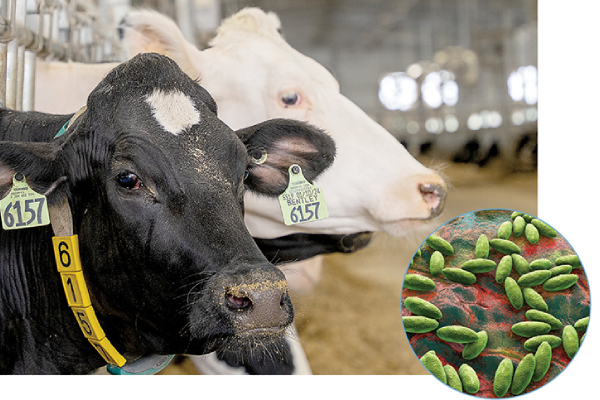
Immune cells called macrophages engulf the bacteria, which uses a secretion system to avoid destruction and redirect itself into a protected compartment.
Inside the macrophage, Brucella senses danger and prepares for the attack by stockpiling genetic instructions inside what look like blobs in a lava lamp. These blobs, called Br bodies, are different from other parts of the cell because they’re not surrounded by a membrane. That means Brucella can quickly build a storage blob and get rid of it just as fast, just like you might put on a jacket when it’s cold and take it off when the weather warms.
When the bacterium finds itself inside an immune cell, those genetic instructions are ready to be translated into proteins almost instantly, allowing the pathogen to respond far more quickly.
Recreating real-life scenarios
Crosson’s lab is studying the genes and protein regions that allow Br bodies to form. If they can knock out Brucella’s ability to form the blobs, the bacterium becomes vulnerable inside macrophages. The work also supports a longer-term effort in collaboration with the U.S. Department of Agriculture, to identify weakened strains of Brucella that could someday serve as live vaccines to help protect wildlife and, by extension, livestock.
Studying those interactions, however, presents another challenge. Researchers can’t perform every experiment in live cattle. Answering those questions requires more than microscopes and genetics. It requires models that mimic what happens inside an infected animal.
“You can’t do a thousand cow experiments,” said Andrew Olive, associate professor of microbiology, genetics and immunology.
Olive, one of Crosson’s frequent collaborators, created another model using fetal liver cells from mice grown in a tissue culture dish with the right cocktail of nutrients and signaling molecules. The result is millions of lung macrophages that behave like the real thing.
"It’s an animal health problem, but it’s also a human health problem. Brucellosis
is a classic One Health issue."
While lab-created conditions are useful, they aren’t true to real life. To skirt this problem, Crosson partners with MSU’s College of Veterinary Medicine to collect macrophages directly from cow lungs. Researchers there sedate a dairy cow to harmlessly inject saline into its lungs and collect fluid containing macrophages. Then, they take those cells back to the lab and infect them with Brucella.
“Now we’re at the point of real-world bacterium growth in bovine cells,” Crosson said. “We’re able to measure the immune responses to the infection. I’m pretty excited about that project. Our collaborations with MSU veterinarians make that possible.”
Beyond Brucella
This work has broader implications beyond Brucella. Understanding how bacteria develop the capabilities to become pathogens is fundamental research. Scientists can use this base of knowledge and apply it to other pathogens.
For Crosson, all these projects trace back to the same fundamental question: How do bacteria acquire the skills they need to survive?
The answer won’t come overnight.
“When you’re finally at the stage that you have a drug or vaccine, you’re looking at decades of fundamental research to get you to that point,” Olive said.
That’s why Crosson continues studying bacteria that most people will never hear of. Every experiment reveals another clue about how microbes sense the world around them, adapt to new environments and, in some cases, acquire the tools to become dangerous pathogens.
Understanding these basic rules of biology may ultimately help scientists stop the next dangerous pathogen before it puts humans and animals at risk. As MSU researchers tackle One Health challenges, Crosson believes the solutions will begin with understanding the smallest details of how microbes live, adapt and evolve.