Menu
How to Survive a Drought
A plant biologist researches ways for crops to survive extreme weather
By Bethany Mauger |
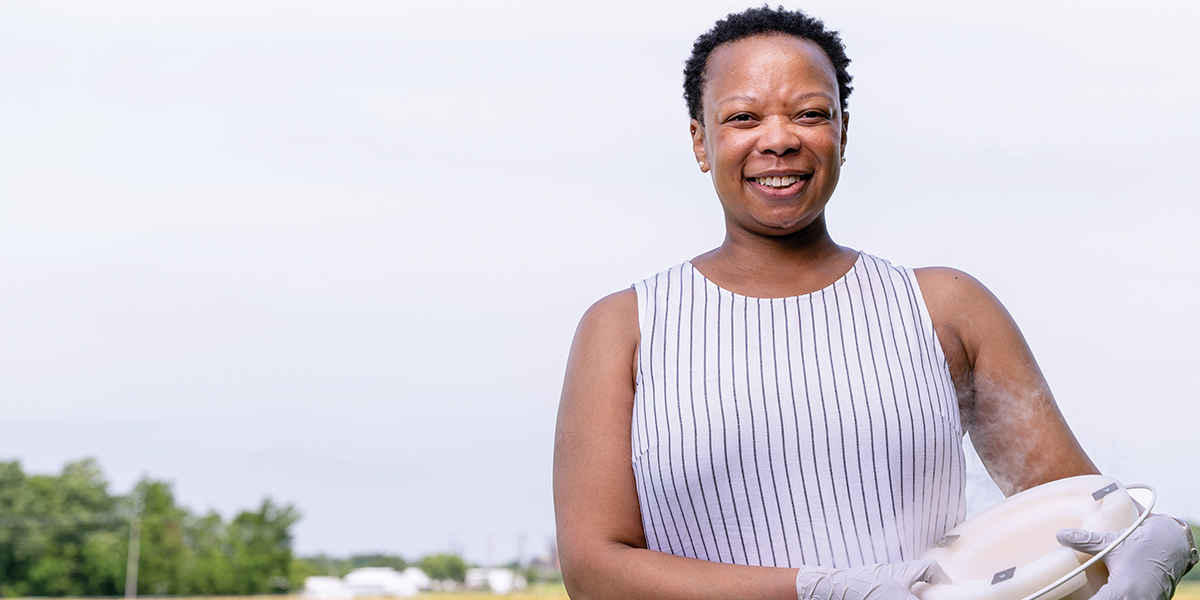
Cornmeal was a staple in Thelma Madzima’s childhood kitchen – that is, when it was available.
Ground maize, as it’s called worldwide, made up most of the meals in her Zimbabwe home. At breakfast, it was cooked into porridge, and for lunch and dinner, it was the main ingredient for Zimbabwe’s staple dish called sadza. Growing up, Madzima ate the thick, savory paste alongside stews, greens or meat at least once a day.
But when droughts struck, grocery store shelves were bare. Imported maize came with a steep price tag, so families resorted to rice or sweet potatoes as a substitute. The portion size of maize became smaller.
Droughts occur about once a decade. Now, they’re as frequent as every few years. And no rain means no maize.
“When a food is part of your culture and you don’t have it, it’s really difficult,” Madzima said. “I remember going to the store and there was just nothing.”
Madzima’s roots are what drove her to become a plant scientist. The MSU 1855 Professor of Plant Biology brought her lab to MSU in 2024 to advance research on genes that help crops withstand drought, heat and extreme weather.
While she’s a fundamental biologist at heart, Madzima is passionate about engaging with farmers and people doing the hands-on work to bring food to the marketplace around the world. She envisions her work moving beyond the lab and into the fields to help the people who need it most.
Defense in their genes
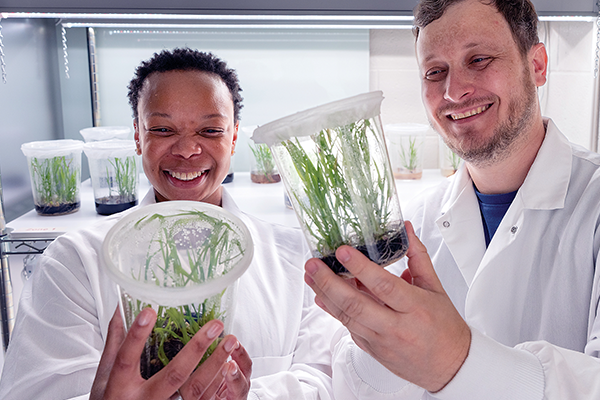
Thelma Madzima (left) and postdoctoral research associate Lucas Baiochi Riboldi (right) examine plant samples in growth chambers.
Plants can’t slather on sunscreen or grab a water bottle to protect them from the summer sun. They’re stuck outside, with only their natural coping mechanisms to protect them from the elements.
“When geese get too cold, they move,” said Lucas Baiochi Riboldi, a postdoctoral researcher in Madzima’s lab. “But plants have to stay put. It’s really cool to see how plants are adapting to weather changes.”
Drought, heat and even salt from winter roads are stresses that can trigger a gene to turn off or shut down to help the plant survive. Through a process called epigenetics, cells can switch genes on or off without changing the underlying DNA sequence.
When the mercury rises and precipitation is scarce, a plant’s leaves might droop or wither. What you don’t see is what’s happening to the molecules inside the plant.
An unusually hot summer might leave epigenetic marks on a maize plant’s DNA. Just as identical twins raised in different environments might behave differently, identical plants in severe climates might grow in completely different ways.
“The plant has to switch its mission,” Madzima said. “They change the genes they were using to grow and be productive to instead survive the stress with enough left to make seeds.”
Those seeds are a research goldmine for Madzima’s team. They use the seed DNA to extract the signals that switch genes on and off, and how those genes help the plant pivot when faced with an obstacle.
Maize isn’t their only teacher. They also examine more resilient plants, like sorghum, to understand what’s happening at a molecular level to apply this information to other crops.
From growth chambers to fields
Studying epigenetics requires a multi-pronged approach. Some team members tend seedlings in grow chambers, where they have the best chance at germinating.
Once they’ve outgrown the tight space, they’re moved to the MSU Plant Science Research Greenhouses. Under both natural and artificial light, maize plants stretch to the ceiling as they’re subjected to different environments. Researchers might crank the heat to simulate hot weather or withhold water as if they’re experiencing a drought.
Madzima’s team also takes their research to the field. In a partnership with the College of Agriculture and Natural Resources, they walk rows of maize and observe how the different traits help the plants survive in a natural environment.
Using all three spaces, the lab team get three growing seasons of experiments.
The different spaces produce dramatically different results. Some of the plants seem to thrive. Others grow cornsilk from the wrong places or seeds in unusual colors and shapes.
“It gives us a unique opportunity to see the mutants and what phenotypes show up in the field,” said Carly Blair, a graduate student in Madzima’s lab. “Sometimes we get really, really weird ones.”
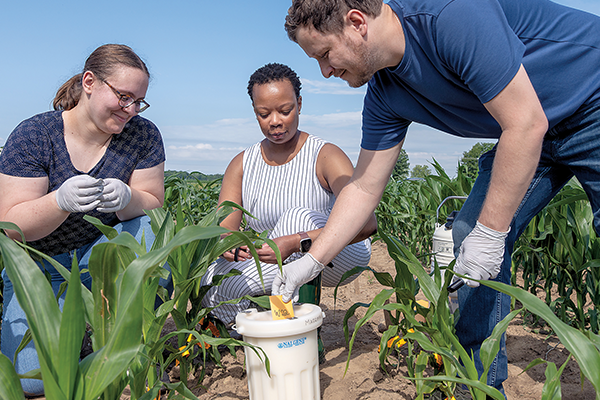
Carly Blair, graduate student, Thelma, and Lucas Baiochi Ribaldi, postdoctoral research associate, of the Madzima Lab grow plants in the field and in growth chambers in order to study samples throughout the year.
Those unusual plants are part of what makes maize such a powerful research tool. Unlike sweet corn that you commonly buy at the store or farmer’s market, starchy maize is typically used for animal feed, high-fructose corn syrup and even biofuels.
This plant is interesting to scientists because of its genome. About 85 percent of it is made up of transposable elements – pieces of DNA that can hop to different spots and insert themselves wherever they want, creating a mutant. Madzima’s team chooses a particular gene it wants to study and obtains seeds from mutant insertion libraries available through the Maize Genetics Cooperation Stock Center.
Baiochi Riboldi uses MSU’s Bioinformatics Core to sequence the plants’ RNA and merge the data from different samples to understand which gene pathways or hormones are responsible for the traits they’re seeing in the plant.
It’s not as simple as finding a heat-resistant gene and switching it on for every plant. Like taking a medication, turning on a gene can also result in unwanted side effects. A gene that helps maize survive heat could make it more susceptible to drought, change its seed production or dramatically alter its appearance.
Seed breeders have cross-pollinated plants to grow bigger watermelons or juicier tomatoes for centuries without knowing what’s happening at the molecular level. Epigenetics can speed up the process. Much like knowing the call number or genre makes searching for a book much faster, knowing the exact gene responsible for drought resistance saves breeders time and money.
Stress in any context, human or plant, is not ideal, adaptation in that context is
very important, because you cannot change your environment.”
Researchers can then examine the same gene pathway in other plants to see if they have similar effects.
They’re up against a ticking clock. Madzima’s team is preparing for a future where today’s extreme weather may no longer seem extreme. They’re developing crops resilient enough to withstand the climate of tomorrow.
They’re building plants to survive a future that at the moment seems unimaginable.
But Madzima focuses on the children in Sub-Saharan Africa. Maybe her team’s research will ensure a future where they don’t have to grow up without an important cultural food. Droughts may come, but her work may ensure that maize is in the marketplace and available on every dinner table.
“Stress in any context, human or plant, is not ideal,” Madzima said. “Adaptation in that context is very important, because you cannot change your environment. The changes start at the cellular and molecular level.”