Menu
An Evolutionary Treasure
How the spotted gar is helping MSU researchers connect fish, humans and millions of years of evolution
By Bethany Mauger |
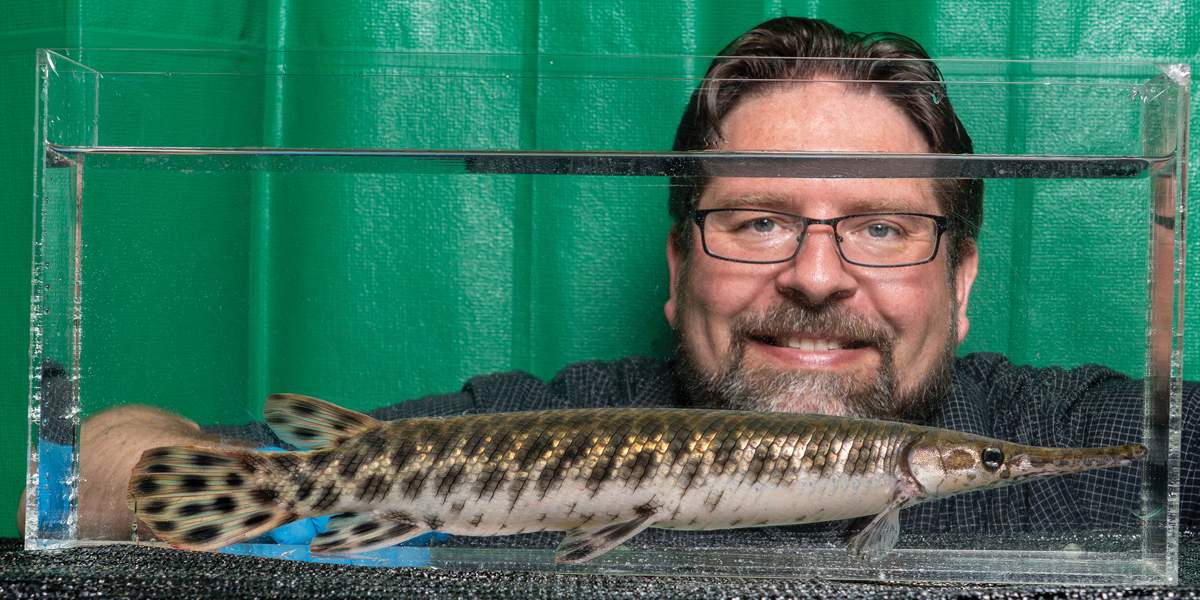
When a spotted gar is caught by a fisherman, it’s usually tossed back in disappointment. The long, bony fish doesn’t make for the tasty meal that a walleye or trout might.
Anglers have long dismissed the spotted gar as a “trash fish”. To Ingo Braasch, however, they’re an evolutionary treasure.
The associate professor of Integrative Biology believes the spotted gar has the potential to help scientists understand vertebrate evolution, as well as human disease. With its slowly evolving genome, he aims to turn the lowly fish into a model organism that can act as a bridge to medical discoveries.
Braasch’s research got a boost in 2020, when he was awarded a $1.6 million National Science Foundation EDGE grant to establish the spotted gar as a model organism for researching evolution, development and human biology.
Thanks to the grant, Braasch and his team have expanded into a 2,000 square foot, one-of-a-kind facility with 12 tanks holding hundreds of gallons of water, where they raise gar from embryos and observe real-life genetic changes in action. Eventually, the goal is to harvest their own eggs and become a self-sustaining facility.
“This is a really cool opportunity to generate something that’s unique to MSU,” Braasch said.
Not-so-distant relatives
Humans and fishes aren’t so different, evolutionarily speaking. Long ago, our fish ancestors developed arms and legs from fins, and lungs from a gas bladder. As land-dwelling vertebrates with four limbs, we’re not too far from being a special kind of fish.
Even today, more than half of all living vertebrate species are fishes.
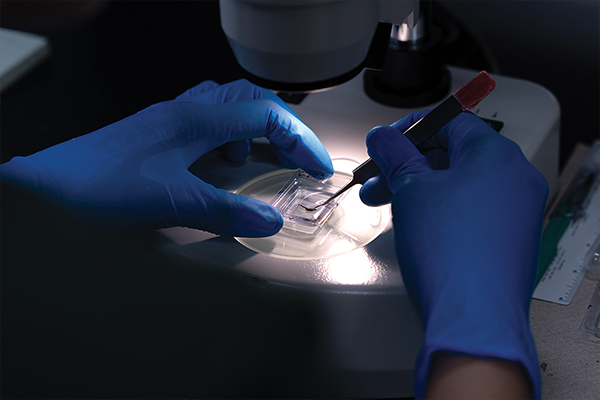
Before scientists can test their research on humans, they first need to work with animal models to eliminate as many variables as possible. Mice and frogs are common in labs, but many research teams are increasingly using zebrafish. They’re popular research models because they’re transparent as embryos, develop quickly and share 70% of their genes with humans.
But despite their commonalities, there’s a wide evolutionary gap between zebrafish and humans.
That’s where the spotted gar swims in.
The “living fossil” serves as a bridge between zebrafish and humans. Because the spotted gar’s genome evolves slowly, Braasch’s team can use it to reconstruct the last living relative between fishes and humans.
Gar are also similar to humans, both evolving much more slowly than modern fish. That means that the comparison between a human genome and a gar’s is closer than between a human and a zebrafish.
“The last common ancestor of fish and human doesn’t exist anymore. Yet the gar is the closest proxy still alive to this long-extinct ancestor.” Braasch said.
An old soul
A cursory glance is enough to understand that the gar isn’t like most fish moving through rivers and lakes. Their scales are tough, almost like a knight’s armor, because they’re made of the same enamel that coats human teeth.
The fish is also known to swim to the surface for a gulp of air. While they breathe through gills, they also have a gas bladder that holds air. Scientists believe that as our fishy ancestors evolved to walk on land, that gas bladder eventually became the terrestrial lung.
Researchers are also interested in the genetic origins of their tail fins, which more closely resemble a shark than a modern fish. And then there’s the question of why the gar has evolved so much slower than every other fish.
Nearly every cell holds a genetic mystery that Braasch wants to investigate.
“Their evolutionary history tells a story,” Braasch said. “They tell us that your teeth are actually fish scales, and your lungs are like gas bladders.”
Pioneering work
The work begins with fish embryos. Braasch works with a partner lab in Louisiana. Every year, they get gar eggs from spawning fish from the southern bayous and ship them north to Michigan. When the eggs arrive, it’s all hands on deck.
For two weeks, the whole lab tracks the embryos’ growth, taking pictures and monitoring their development. They also perform their experiments.
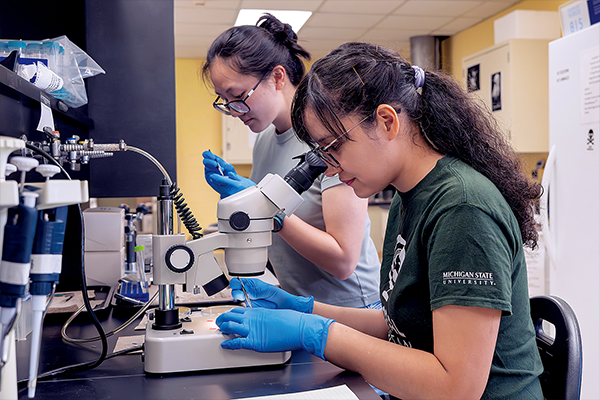
The gar lab uses a scientific process called single-cell sequencing, which allows them to examine the genetic activity of individual cells. Their work reveals differences they’d miss if they were studying cells of an entire organ together.
Researchers map out the genetic instructions dictating each cell, providing the team with a snapshot of which genes are switched on or off, and how active each gene is. The more genetic maps they create, the easier it is to connect the dots from spotted gar to zebrafish, and from zebrafish to human.
“In principle, you can figure out what every cell is doing in the body.” Braasch said.
Ph.D. student Tony Zhou makes sense of those datasets using bioinformatics – a method of analyzing biological information with computers. He spends most of his time hunched over a computer, examining data like a game of red light-green light to understand how genes are expressed in the fish.
Scientists spent decades doing similar work to connect the human genome with that of a mouse. Called the ENCODE project, the multinational effort created an important database of every gene’s role. A similar initiative is already in the works for the zebrafish, but genetic gaps will be difficult to overcome without a bridge to connect the genomes of different species.
Launching the GarCODE project, Braasch believes his lab can perform similar work to create the genetic bridge to link the human and zebrafish initiatives.
“The last common ancestor of fish and human doesn’t exist anymore. Yet the gar is
the closest proxy still alive to this long-extinct ancestor.”
Once they find a gene they’re interested in, they test its role using CRISPR. This technology allows scientists to edit genes or turn them on and off. Then, they step back and observe the changes that result, giving them more information about what that gene does. For example, an albino fish glides through a large black tank thanks to knocking out the gene for making melanin – the same melanin that changes the color of human skin.
Gene by gene, Braasch and his team uncover new clues. Each experiment brings them closer to understanding how vertebrates evolved, and how our own ancestors eventually made their way onto land.
If successful, Braasch will help the spotted gar lose its trash fish reputation by unlocking the evolutionary history hidden in its DNA, supporting the humble fish’s worth.
“We use the gar to learn more about where we came from,” Braasch said.